UNYIL IS FASTER THAN UNTUNG

If this is a race to open young coconut on the island of orangutans, then Unyil orangutan would be the winner. For now, the orangutan island is inhabited by Unyil and Untung only. These two orangutans will be released next month.

Do you still remember Unyil’s background? The orangutan that is like human? Who was always fed with humanised diet? And his hair looked just like been straightened when he entered the Borneo COP orangutan rehabilitation center. The orangutan who was kept in a wooden cage and placed in the bathroom? The orangutan whose birthday was always celebrated every year? The orangutan who was even given a family last name? Yes Unyil, who was rescued from the toilet, will return to its habitat, next month.

While Untung, is an orangutan from a zoo with imperfect fingers. Little Untung who was a bit afraid to climb trees. Next month will be an opportunity to witness him truly wild and return to its habitat.
Coconut is the favourite fruit of both. Usually Unyil immediately grabs the coconut and within 10 minutes can enjoy its meat. Unyil is afraid that Untung would grab his coconut. That is why he could quickly open the coconut. “Unyil.. Unyil… you have to be even more fierce when you are in your habitat later, “Anen said with a smile. (EBO)

UNYIL LEBIH CEPAT DARIPADA UNTUNG
Jika ini sebuah perlombaan membuka kelapa di pulau orangutan, maka orangutan Unyil lah sebagai pemenangnya. Untuk saat ini, pulau orangutan dihuni oleh orangutan Unyil dan Untung saja. Kedua orangutan ini adalah orangutan yang akan dilepasliarkan pada bulan depan.

Masih ingat latar belakang Unyil? Orangutan yang diperlakukan seperti manusia ini? Makan selalu didulangi dengan menu seperti manusia? Rambutnya yang terlihat baru saja direbonding saat dia masuk pusat rehabilitasi orangutan COP Borneo. Orangutan yang hidup di kandang kayu dan diletakkan di dalam kamar mandi? Orangutan yang dirayakan setiap hari ulang tahunnya? Orangutan yang bahkan diberi nama belakang keluarga? Ya Unyil yang diselamatkan dari toilet ini akan kembali ke habitatnya, bulan depan.

Sementara Untung, adalah orangutan yang berada di kebun binatang dengan jari yang tidak sempurna. Untung kecil yang takut-takut memanjat pohon. Bulan depan akan menjadi sebuah kesempatan untuk menyaksikannya benar-benar liar dan kembali ke habitatnya.

Buah kelapa menjadi buah kesukaan keduanya. Biasanya Unyil langsung mendekap kelapa tersebut dan dalam waktu 10 menit sudah bisa menikmati isinya. Unyil pun takut buah kelapanya direbut Untung, itu sebabnya dia dapat dengan cepat membuka kelapa. “Unyil… Unyil… kamu harus lebih galak lagi ya kalau di habitatmu nanti.”, ujar Anen sambil tersenyum. (Anen_CB)

MARY AT THE FIRST DAY OF FOREST SCHOOL

This is a bright morning to start the forest school class. When the cage doors opened, little orangutans are lively out of the cage. Some are directly in the arms of the animal keeper, some are waiting below and there are those who can’t wait to pull the animal keeper’s hand and start walking into the forest.

Today is so special. Mary will be in the forest school class for the first time. Mary was immediately surrounded by other orangutans. Annie, Happi, Jojo, Owi, Bonti and Popi approached Mary. They sniffed and … examined Mary’s genital. It seems they are checking, Mary is female or male. “Geez!!!”
Annie pulled her hair, pressed and rolled Mary. Do you still remember when Annie first entered the forest school class? Annie got a hard hit? For Mary … every orangutan is busy checking lower part of her body.

The sun is right above the head, Mary climbs the tree through the hanging roots. She moves from one tree to another. Mary looks good at climbing and exploring. Maybe this ability, she got from her mother when they were together. “, Said Jhonny, coordinator of Borneo COP animal keeper. (EBO)

MARY DI HARI PERTAMA KELAS SEKOLAH HUTAN
Pagi ini cukup cerah memulai kelas sekolah hutan. Pintu-pintu kandang dibuka. Orangutan-orangutan kecil dengan lincah keluar dari kandang, ada yang langsung berada di gendongan animal keeper, ada yang menunggu di bawah dan ada yang tak sabar menarik tangan animal keeper dan mulai berjalan masuk ke hutan.

Hari ini menjadi begitu istimewa. Mary akan masuk kelas sekolah hutan untuk pertama kalinya. Mary langsung dikelilingi orangutan-orangutan lainnya. Annie, Happi, Jojo, Owi, Bonti dan Popi mendekati Mary. Mereka mengendus dan… memeriksa kemaluan Mary. Sepertinya mereka memeriksa, Mary betina atau jantan. “Ya ampun!!!”

Annie menarik rambutnya, menekan dan menggulingkan Mary. Masih ingat saat Annie pertama kali masuk kelas sekolah hutan? Annie mendapatkan pukulan keras? Kalau Mary… setiap orangutan sibuk memeriksa bagian bawah tubuhnya.

Matahari tepat di atas kepala, Mary memanjat pohon melalui akar-akar yang bergelantungan. Dia berpindah dari satu pohon ke pohon yang lain. Mary terlihat sudah pandai memanjat dan menjelajah. Mungkin kemampuan ini, ia dapatkan dari induknya sewaktu bersama.”, ujar Jhonny, kordinator animal keeper COP Borneo. (Jhonny_CB)

74 BULLETS: THIS IS A CRIME AGAINST ORANGUTAN!

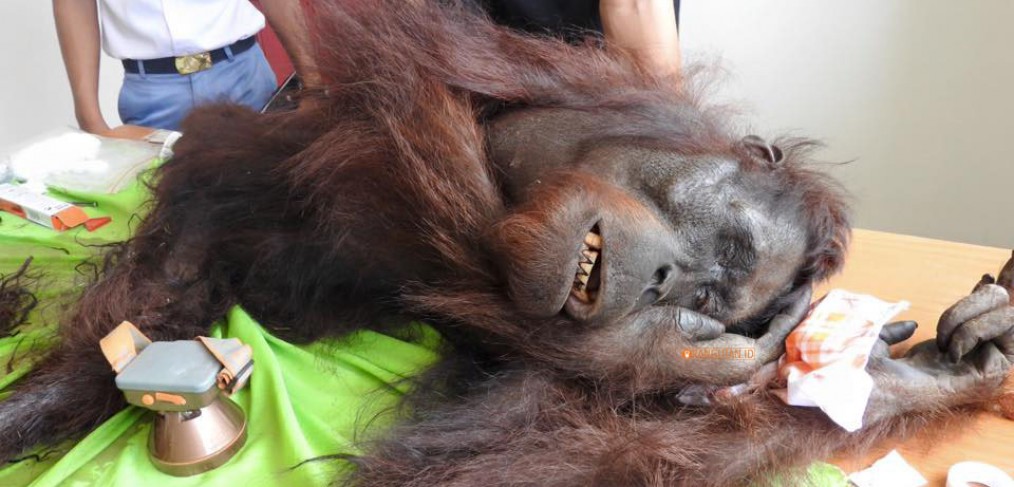
This morning, Center for Orangutan Protection reported the case of orangutan that was injured with 74 rifle bullets to the Tipidter Bareskrim Police Directorate in Jakarta. “This is a serious crime, demanding the police immediately to thoroughly investigate the case and bring perpetrators before the law” said Hery Susanto, coordinator of the Anti Wildlife Crime COP.

The injured female orangutan was named Hope. Hope was forced to lose her child because of the very weak condition of the orangutan and malnutrition. While both of Hope’s eyes were blind due to air rifle bullets lodged in his eyes.

Based on Law Number 5 of 1990, Article 21 paragraph 2 point (a): “Every person is prohibited from arresting, injuring, killing, storing, possessing, maintaining, transporting and trading protected animals in a living condition.”. With this COP presents a criminal action report on the Sumatran Orangutan (Pongo abelii) that occurred in Bunga Tanjung village, Sultan Daulat District, Subulussalam, Aceh.

74 PELURU: INI KEJAHATAN TERHADAP ORANGUTAN
Pagi ini, Centre for Orangutan Protection melaporkan orangutan dalam kondisi terluka dengan 74 peluru senapan angin ke Direktorat Tipidter Bareskrim Polri, Jakarta. “Ini adalah kejahatan serius, mohon pihak kepolisian segera mengusut tuntas pelaku penembakan orangutan tersebut.”, ujar Hery Susanto, kordinator Anti Wildlife Crime COP.

Orangutan betina yang terluka tersebut diberi nama Hope. Hope terpaksa kehilangan anaknya karena kondisi anak orangutan tersebut yang sangat lemah dan mal nutrisi. Sementara kedua mata Hope buta akibat peluru senapan angin yang bersarang di kedua matanya.

Berdasarkan Undang-Undang Nomor 5 Tahun 1990, pasal 21 ayat 2 poin (a): “Setiap orang dilarang untuk menangkap, melukai, membunuh, menyimpan, memiliki, memelihara, mengangkut dan memperniagakan satwa yang dilindungi dalam keadaan hidup.”. Dengan ini COP menyampaikan laporan tindak pidana pada Orangutan Sumatera (Pongo abelii) yang terjadi di desa Bunga Tanjung, Kecamatan Sultan Daulat, Subulussalam, Aceh.

COP juga menyampaikan siap untuk memberikan bantuan teknis dalam penyelidikan kasus ini.

WHAT JHONNY SAYS ABOUT JOJO

Jojo is a 2-year-old female orangutan. Jojo the orangutan has thick, straight and long hair with a sad and flat facial expression. The orangutan was confiscated by the BKSDA from the village of Rantau Pulung then entrusted to COP Borneo, the rehabilitation center for orangutans in Berau, East Kalimantan.

Jojo is placed in a 3 × 3 meters and 6 meters high cage. She looked very happy when the animal keeper tied up various kinds of fruits such as watermelon, corn, tomatoes, pineapple, bananas and also a glass of milk. In no time Jojo soon enjoyed the fruits until nothing left.

Jojo is an orangutan that residents kept illegally. Since then, Jojo never ate fruit and only occasionally drank milk. She lived in a 50 x 50 x 50 cm cage where she could not even stand up straight. But it was in the past.

Now Jojo lives her new life, meets new friends, is in a new place and joins a forest school. A school in the rehabilitation center that trains her and other orangutans to live in their own way. Jojo only needs to adapt to the surrounding environment, by climbing, exploring the canopy of trees, searching for forest fruit, eating tree bark and learning to make nests in trees.

Jhonny is an animal keeper who has helped saving Jojo. Memories about Jojo are still imprint clearly. Seeing Jojo now makes him even more excited. Jojo never missed the forest school class. In fact, she often tries to find the opportunity to always go to forest school. Let’s encourage Jojo through https://www.kitabisa.com/orangindo4orangutan(EBO)

KATA JHONNY TENTANG JOJO
Jojo adalah orangutan betina berumur 2 tahun. Orangutan Jojo dengan rambutnya yang lebat, lurus dan panjang ini memiliki ekspresi wajah yang sedih dan datar. Orangutan Jojo berasal dari kampung Rantau Pulung dan merupakan sitaan BKSDA dan dititipkan ke COP Borneo, pusat rehabilitasi orangutan di Berau, Kalimantan Timur.

Jojo ditempatkan dalam kandang 3 x 3 meter dan tinggi 6 meter. Dia terlihat sangat gembira ketika animal keeper memberikat berbagai macam buah-buahan seperti semangka, jagung, tomat, nanas, pisang dan tak lupa juga segelas susu. Tak menunggu lama, Jojo langsung menikmati buah-buahan tersebut hingga habis.

Jojo adalah orangutan yang dipelihara warga secara ilegal. Sejak itu pula, Jojo tak pernah makan buah dan sesekali minum susu. Hidup di dalam kandang 50 x 50 x 50 cm bahkan untuk berdiri dalam kandang pun tak bisa. Tapi itu dulu.

Kini Jojo menjalani hidupnya yang baru, bertemu teman baru, berada di tempat yang baru dan bergabung dalam sekolah hutan. Sekolah di pusat rehabilitasi yang melatih cara hidup orangutan dengan caranya sendiri. Jojo hanya perlu beradaptasi dengan alam sekitar, dengan memanjat, menjelajah di atas kanopi pohon, mencari buah hutan, memakan kulit pohon dan belajar membuat sarang di atas pohon.

Jhonny adalah animal keeper yang ikut menyelamatkan Jojo. Ingatan tentang Jojo masih sangat membekas. Melihat Jojo yang sekarang membuatnya semakin bersemangat. Jojo bahkan tidak pernah menghindar dari kelas sekolah hutan. Bahkan sering mencuri kesempatan untuk selalu ikut ke sekolah hutan. Beri semangat untuk Jojo yuk melalui https://www.kitabisa.com/orangindo4orangutan (Jhonny_CB)

AGAIN, AN ORANGUTAN SHOT WITH 74 AIR RIFFLE BULLETS

A shocking news from the Orangutan Information Center in Bunga Tanjung village, Sultan Daulat sub-district, Subussalam city, Aceh. One female orangutan with her baby was found on a plantation owned by a local resident. Sunday, March 10, 2019 the OIC HOCRU team together with the Aceh BKSDA and WCS managed to save the orangutan mother named Hope. Hope’s condition was severe with injuries from sharp objects in her right hand, left fingers and right foot. In both of her eyes wounded by air rifle bullets. In its journey, the orangutan baby who is only one month old cannot be saved because of trauma and malnutrition. Both were taken to the SOCP rehabilitation center in North Sumatra.

Today, March 12, 2019, the Sumatran Orangutan Conservation Program (SOCP) conducted a medical examination and found 74 rifle bullets in Hope’s body. Air rifle bullets also blinded her eyes. There are fractured bones in his hands and feet.

“The rules for using air rifles are clear. 74 rifle bullets that nest in Hope’s body are not accidental. This is a crime. Come on, Aceh Regional Police, arrest the perpetrators. Ministry of Environment and Forestry, orangutans are still protected animals right? The Center for Orangutan Protection is ready to help, “said Ramadhani, the Center for Orangutan Protection and Orangutan Protection Campaign Manager.

As a reminder, the District Court (PN) for the case of an orangutan’s death with 130 air rifle bullets in Teluk Pandan, East Kutai District, East Kalimantan stated that the four defendants were found guilty and sentenced to seven months and with Rp. 50,000,000 fine and a subsidiary of 2 months in prison.
#TerorSenapanAngin
LAGI, ORANGUTAN DITEMBAK DENGAN 74 PELURU SENAPAN ANGIN
Berita mengejutkan dari Orangutan Information Centre di desa Bunga Tanjung, kecamatan Sultan Daulat, kota Subussalam, Aceh. Satu individu orangutan betina dengan anaknya ditemukan di perkebunan milik warga setempat. Minggu, 10 Maret 2019 tim HOCRU OIC bersama BKSDA Aceh dan WCS berhasil menyelamatkan induk orangutan yang diberi nama Hope. Kondisi Hope cukup parah dengan luka-luka dari benda tajam pada tangan kanan, jari kiri dan kaki kanannya. Pada kedua matanya luka akibat peluru senapan angin. Dalam perjalanannya, bayi orangutan yang baru berusia 1 bulan tidak dapat diselamatkan karena trauma dan malnutrisi (Foto:OIC). Keduanya dibawa ke pusat rehabilitasi SOCP di Sumatera Utara.

Hari ini, 12 Maret 2019, Sumatran Orangutan Conservation Programme (SOCP) melakukan pemeriksaan medis dan ditemukan 74 peluru senapan angin di tubuh Hope. Peluru senapan angin juga membuat kedua matanya buta. Terdapat tulang retak pada tangan dan kakinya.

“Aturan penggunaan senapan angin sudah jelas. 74 peluru senapan angin yang bersarang di tubuh Hope bukan tanpa sengaja. Ini adalah kejahatan. Ayo Polda Aceh, tangkap pelakunya. Kementrian Lingkungan Hidup dan Kehutanan, orangutan masih satwa yang dilindungi Undang-Undang kan? Centre for Orangutan Protection siap membantu.”, kata Ramadhani, Manajer Kampanye Perlindungan Orangutan dan Habitatnya Centre for Orangutan Protection.

Sebagai catatan, Pengadilan Negeri (PN) Kutim untuk kasus kematian orangutan dengan 130 peluru senapan angin di Teluk Pandan, Kabupaten Kutai Timur, Kalimantan Timur menyatakan keempat terdakwa terbukti bersalah dan divonis tujuh bulan dan dengan Rp 50.000.000,00 subsider 2 bulan kurungan.

THREATENING ORANGUTAN, PALM OIL COMPANY, PT. GPM REPORTED TO KPK

Centre for Orangutan Protection urged the Corruption Eradication Commission to examine allegations of corruption in permit granting process related to the oil palm plantation business of PT. GPM in Berau district, East Kalimantan. PT. GPM is a subsidiary of PS Group which has a long track record in endangering the Borneo Orangutan (Pongo pygmaeus morio) and its habitat. Threat on orangutans is a clear evidence that there is something wrong with granting licenses, both technically and administratively, that involve all parties, the local government, companies and environmental consultants. COP also submitted a report on a case that had occurred previously at PT. AE, another PS Group subsidiary operating in East Kutai as supporting material for the investigation.

The concession area of PT. GPM is an area that has High Conservation Value, an important habitat for orangutans. Based on a survey conducted by BOSF, the density of orangutans in the concession area of PT. GPM reaches 2.54 individuals / km2, and there are 234 tree species (38% of orangutan tree species). When conducting a field check the Centre for Orangutan Protection team found orangutan along with her baby were in the location being cleared. The East Kalimantan BKSDA with the assistance of the COP has twice transferred adult male orangutans begging for food on the road side in the concession area of PT. GPM. It is estimated that these orangutans are very hungry and forested areas that are the source of food have been cleared. Besides those begging orangutans, COP also found female orangutans and their children in the same area.

The Bornean Orangutan (Pongo pygmaeus morio) is one of the most protected wildlife species in Indonesia under Law No. 5 of 1990 concerning Conservation of Biodiversity and its Ecosystem. The population continues to decline due to deforestation for palm oil plantations. The Centre for Orangutan Protection greatly appreciates KPK in arresting the local government heads that involved in corruption related to granting permits of forest and land-based business in Kalimantan. The PS Group’s case is expected to be one of the KPK’s important achievements in preventing state’s greater losses in the forestry sector.

For more information and interviews please contact:
Ramadhani
Campaign Manager
Centre for Orangutan Protection
Mobile: 081349271904
Email: info@orangutanprotection.com

MENGANCAM ORANGUTAN, PERUSAHAAN SAWIT PT.GPM DILAPORKAN KE KPK
Centre for Orangutan Protection meminta Komisi Pemberantasan Korupsi untuk memeriksa dugaan korupsi dalam proses pemberian ijin – ijin yang berkaitan dengan usaha perkebunan kelapa sawit PT. GPM di kabupaten Berau, Kalimantan Timur. PT. GPM merupakan anak perusahaan PS Group yang memiliki rekam jejak panjang dalam membahayakan Orangutan Kalimantan (Pongo pygmaeus morio) dan habitatnya. Terancamnya orangutan merupakan bukti yang jelas dan terang bahwa ada yang keliru dalam pemberian ijin, baik secara teknis maupun administrasi, yangmana ini bisa melibatkan para pihak secara bersama – sama, baik Pemerintah Daerah, perusahaan dan konsultan lingkungan. COP juga menyerahkan laporan atas kasus yang terjadi sebelumnya di PT. AE, anak perusahaan PS Group lainnya yang beroperasi di Kutai Timur sebagai bahan pendukung penyelidikan.

Kawasan konsesi PT. GPM merupakan kawasan yang memiliki Nilai Konservasi Tinggi, habitat penting bagi orangutan. Berdasarkan survei yang dilakukan oleh BOSF, kepadatan orangutan di kawasan konsesi PT. GPM mencapai 2,54 individu/km2, serta terdapat 234 spesies pohon (38% spesies pohon pakan orangutan). Pada saat melakukan cek lapangan tim Centre for Orangutan Protection mendapati 1 (satu) individu orangutan berserta anaknya berada di lokasi yang sedang dilakukan pembabatan. BKSDA Kaltim dengan dibantu COP telah 2 (dua) kali mentranslokasikan orangutan jantan dewasa yang mengemis makanan di tepian jalan raya yang berada di dalam kawasan konsesi PT. GPM. Diperkirakan, orangutan – orangutan tersebut sangat kelaparan dan kawasan berhutan yang menjadi sumber makanan telah dibabat. Selain orangutan – orangutan jantan yang mengemis tersebut, COP juga pernah menemukan orangutan – orangutan betina dan anaknya di kawasan yang sama.

Orangutan Kalimantan (Pongo pygmaeus morio) merupakan salah satu spesies satwa liar yang paling dilindungi di Indonesia berdasarkan Undang – Undang Nomor 5 Tahun 1990 tentang Konservasi Keanekaragaman Hayati dan Ekosistemnya. Populasinya terus merosot dikarenakan pembabatan hutan untuk membuka perkebunan kelapa sawit. Centre for Orangutan Protection sangat mengapresasi kerja – kerja KPK dalam menangkap para Kepala Daerah yang terlibat korupsi dalam pemberian ijin – ijin usaha berbasis lahan dan hutan di Kalimantan. Kasus PS Group ini diharapkan akan menjadi salah satu capaian penting KPK dalam mencegah kerugian negara yang lebih besar di bidang kehutanan.

Untuk informasi lebih lanjut dan wawancara silakan menghubungi:
Ramadhani
Manajer Kampanye
Centre for Orangutan Protection
HP: 081349271904
Email: info@orangutanprotection.com

WILD LITTLE ALOUISE

Unfotunately, this litle orangutan’s life must end up in human hands again. Saturday, March 9, 2019, this male orangutan entered the quarantine cage of the COP Borneo orangutan rehabilitation center, in Berau, East Kalimantan.

Alouise looked scared when approached. His fear was shown by the more aggressive and wild behavior. His small body was not strong enough to fight, finally Alouise bit. His small, sharp teeth landed when he was removed from the transport cage.

Currently, he is adjusting to the enclosure at the COP Borneo clinic. The medical team will immediately evaluate his health both physically and laboratory. “I don’t know the story, especially until Alouise fell into human hands. Maybe the mother has been killed. “, Said veterinarian Flora, watching her.

SI KECIL ALOUISE NAN LIAR
Sayang sekali, orangutan kecil ini harus berakhir di tangan manusia lagi. Sabtu, 9 Maret 2019, orangutan berjenis kelamin jantan ini masuk kandang karantina pusat rehabilitasi orangutan COP Borneo, di Berau, Kalimantan Timur.

Alouise terlihat takut saat didekati. Rasa takutnya ditunjukkannya dengan semakin agresif dan liarnya tingkahnya. Tubuh kecilnya tak cukup kuat untuk melawan, akhirnya Alouise pun mengigit. Giginya yang kecil dan tajam pun mendarat saat dia dikeluarkan dari kandang angkut.

Saat ini, dia sedang menyesuaikan diri dengan kandang yang ada di klinik COP Borneo. Tim medis akan segera mengevaluasi kesehatannya baik secara fisik dan laboratorium. “Entah cerita apalagi hingga Alouise sampai jatuh ke tangan manusia. Mungkin induknya sudah mati terbunuh.”, ujar dokter hewan Flora sambil memperhatikannya.

POPI’S STYLE AND BANANA IN FOREST SCHOOL

The way Popi climbs trees in a forest school class can be distinguished from other orangutans of her age. Quick, then slow down and look back at the animal keeper. “Let’s see when you are as Happi’s age, or six months later. You won’t care about me anymore Pop! ” Shouted Wety Rupiana, the baby sitter who has been taking care of her since birth.

His style this time, yes while eating bananas, her hands and feet were busy holding on branches. Itching in her armpits is unbearable, there may be ants that bite her again. “Only by holding on with one hand she was busy scratching her armpit. Not forgetting to look at me. Ask for help?” Wety thought a little worried.

A month ago Popi chose the wrong food. She thought, weathered wood always contained delicious termites. In fact, the weathered wood she got contained large ants that bit mercilessly. Popi tried to get rid of the ants that bit her. “Well Popi, experience is the best teacher. Don’t be fooled again.”. (EBO)

GAYA POPI DAN PISANG DI SEKOLAH HUTAN
Cara Popi memanjat pohon di kelas sekolah hutan bisa dibedakan dengan orangutan seumurannya. Cepat, kemudian melambat dan tak lupa melihat ke animal keeper. “Lihat saja nanti kalau kamu sudah seumuran Happi, atau enam bulan kedepan. Kamu tidak akan mempedulikan aku lagi ya Pop!”, teriak Wety Rupiana, baby sitter Popi sejak tali pusar Popi mulai mengering.

Gaya nya kali ini, ya sambil manjat makan pisang, tangan dan kakinya sibuk berpegangan. Gatal di ketiaknya tak tertahankan lagi, mungkin ada semut yang mengigitnya lagi. “Hanya dengan berpegangan satu tangan dia pun sibuk menggaruk ketiaknya. Tak lupa sambil melihatku. Minta tolong?”, pikir Wety sedikit kawatir.

Dua bulan yang lalu Popi salah memilih makanannya. Dipikirnya, kayu lapuk selalu berisi rayap yang enak. Nyatanya, kayu lapuk yang dipegangnya berisi semut besar yang menggigit tanpa ampun. Popi pun berusaha membuang semut-semut yang menggigitinya. “Baiklah Popi, guru terbaik adalah pengalaman. Jangan sampai tertipu lagi ya.”.

ORANGUTAN’S LETTER TO MR. PRESIDENT JOKOWI

H. E. Joko Widodo

President of the Republic of Indonesia Istana Merdeka
Jakarta Pusat 10110
Indonesia

Dear President Widodo,
Like you, we care deeply about conservation and creating economic growth opportunities that preserve and sustain the environment. Indonesia’s natural beauty is admired and appreciated around the world. Indonesia hosts one of the highest levels of biodiversity on earth. Already, Indonesia is demonstrating leadership in the international community and at home.
We commend your vision to lead Indonesia into a new era of climate action, pledging to reduce Indonesia’s emissions growth by up to 41 percent below business as usual by 2030, and to help the people and natural heritage of Indonesia by curbing deforestation and rehabilitating 12 million hectares of degraded land. This vision of environmentally responsible growth has the potential to boost Indonesia’s global market access by allowing the country to become a globally recognized source of responsibly sourced products, boosting the economy.
A key element of environmentally responsible growth is sustainable infrastructure. Done right, energy and infrastructure projects have the potential to drive economic growth and help people while channeling development in ways that do not adversely affect the environment.
In that context, we urge you to take a heroic action to protect the newly-discovered Tapanuli orangutan by canceling construction of the proposed Batang Toru dam project. The Batang Toru dam was authorized before the Tapanuli orangutan species (Pongo tapanuliensis) was identified in 2017 by scientists (including Anton Nurcahyo, Dyah Perwitasari-Farajallah, Puji Rianti, and Joko Pamungkas from Indonesia). As such, their habitat is globally important, and the conservation of the Tapanuli orangutan has become both an Indonesian and international conservation priority. There are just eight living great ape species, and we know that your actions to protect the Tapanuli orangutan would be long celebrated, a powerful piece of your legacy to Indonesia.
There are other key new pieces of information about the project that merit its reconsideration and cancellation:
• With only an estimated 800 Tapanuli orangutans in existence, this new species is designated as critically endangered. Modeling suggests that if more than one percent of the population is depleted each year – more than 8 individuals – the species will go extinct. 

• The Batang Toru dam will mean extinction for the Tapanuli. This project was conceived and planned more than half a decade before the new species was identified, so it could not have taken into account its impact on the Tapanuli. 

• The project has not taken into account the impact of the hydroelectric dam and supporting infrastructure on the Tapanuli Orangutan in its AMDAL (environmental impact assessment). 

• Indigenous Peoples in North Sumatra say that the project will evict them from their ancestral lands. 

We encourage you to review the dam’s siting and work with the relevant local government agencies to identify alternative options for increasing energy production, such as solar or geothermal. For example, the Sarulla geothermal electricity project that currently provides electricity to the area could be expanded without adversely impacting orangutans.
At the end of the day, it would be a tragedy to drive the extinction of the Tapanuli orangutan for a mere 510 megawatts of energy, less than one percent of Indonesia’s generation capacity – especially when overcapacity is a significant concern and the nearby Sarulla geothermal facility could be expanded, providing clean energy to support the region’s infrastructure and development. There is ample financing available that can help develop this and other clean energy sources as an alternative.
In light of the recent scientific and conservation developments, we beg you to secure a future for one of Indonesia’s natural wonders. Please cancel the dam. Take steps to protect the Tapanuli orangutan and the broader Batang Toru ecosystem for the long term by introducing legislation to recognize its special status and protect the area from all forms of industrial development.
Thank you for your consideration. We would welcome a dialogue on this issue and other opportunities to promote environmentally responsible growth in Indonesia.

Sincerely,
Former U.S. Congressman Henry Waxman (Mighty Earth, Chairman)
Former U.S. Secretary of Commerce and U.S. Ambassador to China Gary Locke
Former U.S. Congressman and Chairman of the House Foreign Affairs Committee Howard Berman Former U.S. Congressman George Miller
The Honorable Zac Goldsmith, MP United Kingdom
Former U.S. Ambassador to Indonesia Robert Blake, Jr. (Board Co-Chair, US-Indonesia Society) Former U.S. Ambassador to Indonesia Cameron Hume
Chelsea Clinton and Marc Mezvinsky
Alison Sudol, Actress, Singer/Songwriter and IUCN Goodwill Ambassador
Panut Hadisiswoyo – Orangutan Information Center
Hardi Baktiantoro, Center for Orangutan Protection
Franky Samperante, PUSAKA
Farwiza Farhan, Yayasan HAkA
Kusnadi Oldani, FOKUS [Forum Orangutan Sumatra]
Teguh Surya, Madani
Karlo Lumban Raja, Sawit Watch
Helen Buckland, Sumatran Orangutan Society
Dr. Ian Redmond, Chairman of Ape Alliance
“Marc Ancrenaz, Dr. med. vet. (PhD). HUTAN – Kinabatangan Orang-utan Conservation Programme Scientific Director”
Leif Cocks, President – The Orangutan Project
Michelle Desilets, Orangutan Land Trust
Irena Wettstein, PanEco Foundation
Dr Ian Singleton, Sumatran Orangutan Conservation Programme Erik Meijaard, Adjunct Professor, University of Queensland Upreshpal Singh, Friends of the Orangutans
Dr. William Laurance (scientist, conservationist, and founder of ALERT)
Russell A. Mittermeier, Ph.D., IUCN SSC Primate Specialist Group Chair and Global Wildlife Conservation Chief Conservation Officer
Dirck Byler, IUCN SSC Primate Specialist Group, Section on Great Apes, Chair
Rebecca Kormos, Ph.D., IUCN SSC Primate Specialist Group, Section on Great Apes, Deputy Vice-Chair Serge Wich, Ph.D., IUCN SSC Primate Specialist Group, Section on Great Apes, Vice-Chair
Karen B. Strier, President, International Primatological Society
Bill McKibben, Founder, 350.org
Anja Lillegraven, Rainforest Foundation Norway
James Askew, Research Fellow at Carnegie Institution for Science
Michael Brune, Sierra Club
Fatah Sadaoui and Rebecca Falcon, SumofUs
Iain Keith, Avaaz.org

Kepada Yang Terhormat:
Bapak Ir. Joko Widodo
Presiden Republik of Indonesia
Istana Merdeka
Jakarta Pusat 10110
Indonesia

Bapak Presiden yang Terhormat,

Seperti Anda, kami sangat peduli akan konservasi dan menciptakan peluang pertumbuhan ekonomi yang pada saat yang sama melestarikan dan menjaga kelestarian lingkungan. Keindahan alam Indonesia dikagumi dan dihargai di seluruh dunia. Indonesia memiliki salah satu tingkat keanekaragaman hayati tertinggi di dunia. Indonesia saat ini telah menunjukkan kepemimpinannya dalam komunitas internasional dan di dalam negri.

Kami menghargai visi Anda dalam memimpin Indonesia menuju era baru aksi iklim, janji Anda untuk mengurangi kenaikan emisi Indonesia hingga 41 persen di bawah kondisi yang sama pada tahun 2030, dan membantu masyarakat dan warisan alam Indonesia dengan mengurangi deforestasi dan merehabilitasi 12 juta hektar lahan kritis. Visi pertumbuhan yang bertanggung jawab terhadap lingkungan ini berpotensi meningkatkan akses pasar global Indonesia dan membuka kesempatan bagi Indonesia menjadi penghasil barang yang diproduksi secara bertanggung jawab dan diakui secara global, serta meningkatkan perekonomian.
 
Elemen kunci dari pertumbuhan yang bertanggung jawab terhadap lingkungan adalah infrastruktur yang berkelanjutan. Bila dilakukan dengan benar, proyek-proyek energi dan infrastruktur berpotensi mendorong pertumbuhan ekonomi dan membantu masyarakat serta menyalurkan pembangunan menuju cara yang tidak berdampak buruk terhadap lingkungan.
 
Dalam konteks itu, kami mendesak Anda untuk mengambil tindakan heroik untuk melindungi spesies orangutan Tapanuli yang baru ditemukan dengan membatalkan usulan pembangunan proyek bendungan Batang Toru. Pembangunan bendungan Batang Toru disetujui sebelum spesies orangutan Tapanuli (Pongo tapanuliensis) diidentifikasi pada tahun 2017 oleh para ilmuwan (termasuk Anton Nurcahyo, Dyah Perwitasari-Farajallah, Puji Rianti, dan Joko Pamungkas dari Indonesia). Dengan demikian, habitat mereka penting secara global, dan konservasi orangutan Tapanuli telah menjadi prioritas konservasi Indonesia dan internasional. Di dunia, hanya hidup delapan spesies kera besar, dan kami tahu bahwa tindakan Anda melindungi orangutan Tapanuli dirayakan untuk waktu yang lama, dan merupakan warisan Anda yang kuat untuk Indonesia.

Ada beberapa informasi kunci baru lain yang dapat dipertimbangkan untuk pembatalan atau pengkajian ulang proyek ini:

• Karena diperkirakan adanya hanya 800 orangutan Tapanuli, spesies baru ini ditetapkan sebagai sangat terancam punah. Pemodelan menunjukkan bahwa jika lebih dari satu persen populasi ini, atau lebih dari 8 individu, hilang setiap tahun maka spesies ini akan punah.
• Bendungan Batang Toru akan mengakibatkan kepunahan untuk spesies Tapanuli. Proyek ini disusun dan direncanakan lebih dari setengah dekade sebelum spesies baru diidentifikasi, sehingga tidak dapat memperhitungkan dampaknya pada spesies Tapanuli.
• Proyek ini tidak memperhitungkan dampak bendungan listrik tenaga air dan infrastruktur pendukungnya terhadap Orangutan Tapanuli dalam AMDAL (analisis mengenai dampak lingkungan).
• Masyarakat adat Sumatera Utara mengatakan bahwa proyek ini akan mengusir mereka dari tanah leluhurnya.

Kami mendorong Anda untuk meninjau lokasi bendungan dan bekerja dengan lembaga pemerintah daerah terkait untuk mengidentifikasi opsi alternatif untuk meningkatkan produksi energi, misalnya dengan tenaga surya atau panas bumi. Misalnya, proyek listrik panas bumi Sarulla yang saat ini menyediakan listrik ke daerah itu dapat diperluas tanpa berdampak buruk pada orangutan.

Pada akhirnya, akan menjadi tragedi bila kepunahan orangutan Tapanuli terjadi hanya karena pembangkit listrik 510 megawatt, atau kurang dari satu persen kapasitas pembangkitan Indonesia. Terlebih lagi bila kelebihan kapasitas merupakan masalah yang signifikan dan fasilitas panas bumi Sarulla terdekat dapat diperluas dan menyediakan energi bersih untuk mendukung infrastruktur dan pembangunan kawasan. Ada banyak pembiayaan yang tersedia yang dapat membantu mengembangkannya dan sumber energi bersih lainnya sebagai alternatif.

Mengingat perkembangan ilmiah dan konservasi belakangan ini, kami mohon Anda menjaga masa depan salah satu keajaiban alam Indonesia. Tolong batalkan pembangunan bendungan ini. Ambil langkah-langkah untuk melindungi orangutan Tapanuli dan lebih luas lagi ekosistem Batang Toru untuk jangka panjang dengan mengeluarkan undang-undang untuk mengakui status khusus dan melindungi daerah tersebut dari semua bentuk pengembangan industri.

Terima kasih atas pertimbangan Anda. Kami akan mengundang dialog mengenai masalah ini dan peluang lain untuk mempromosikan pertumbuhan yang bertanggung jawab untuk lingkungan di Indonesia.

Hormat kami,
Former U.S. Congressman Henry Waxman (Mighty Earth, Chairman)
Former U.S. Secretary of Commerce and U.S. Ambassador to China Gary Locke
Former U.S. Congressman and Chairman of the House Foreign Affairs Committee Howard Berman Former U.S. Congressman George Miller
The Honorable Zac Goldsmith, MP United Kingdom
Former U.S. Ambassador to Indonesia Robert Blake, Jr. (Board Co-Chair, US-Indonesia Society)
Former U.S. Ambassador to Indonesia Cameron Hume
Chelsea Clinton and Marc Mezvinsky
Alison Sudol, Actress, Singer/Songwriter and IUCN Goodwill Ambassador
Panut Hadisiswoyo, Orangutan Information Center
Hardi Baktiantoro, Centre for Orangutan Protection
Franky Samperante, PUSAKA
Farwiza Farhan, Yayasan HAkA
Kusnadi Oldani, FOKUS [Forum Orangutan Sumatra]
Teguh Surya, Madani
Karlo Lumban Raja, Sawit Watch
Helen Buckland, Sumatran Orangutan Society
Dr. Ian Redmond, Chairman of Ape Alliance
“Marc Ancrenaz, Dr. med. vet. (PhD).HUTAN -Kinabatangan Orang-utan Conservation ProgrammeScientific Director”
Leif Cocks, President -The Orangutan Project
Michelle Desilets, Orangutan Land Trust
Irena Wettstein, PanEco Foundation
Dr Ian Singleton, Sumatran Orangutan Conservation Programme
Erik Meijaard, Adjunct Professor, University of Queensland
Upreshpal Singh, Friends of the Orangutans
Dr. William Laurance (scientist, conservationist, and founder of ALERT)
Russell A. Mittermeier, Ph.D., IUCN SSC Primate Specialist Group Chair and Global Wildlife Conservation Chief Conservation Officer
Dirck Byler, IUCN SSC Primate Specialist Group, Section on Great Apes, Chair
Rebecca Kormos, Ph.D., IUCN SSC Primate Specialist Group, Section on Great Apes, Deputy Vice-Chair
Serge Wich, Ph.D., IUCN SSC Primate Specialist Group, Section on Great Apes, Vice-Chair
Karen B. Strier, President, International Primatological Society
Bill McKibben, Founder, 350.org
Anja Lillegraven, Rainforest Foundation Norway
James Askew, Research Fellow at Carnegie Institution for Science
Michael Brune, Sierra Club
Fatah Sadaoui and Rebecca Falcon, SumofUs
Iain Keith, Avaaz.org

INDONESIAN COALITION URGES GOVERMENT TO SAVE TAPANULI ORANGUTAN, PROTECT “WONDERFUL INDONESIA”

Controversial US$ 1.6 billion dam project backed by China and Dharmawangsa Group threatens extinction of the rare Pongo tapanuliensis orangutan
JAKARTA, 5 March 2019 – The stage is set for a crucial showdown in a long-running battle to save a newly discovered rare species of orangutan from possible extinction at the hands of a planned US$ 1.6 billion hydroelectric dam project. The state administrative court in Medan ruled yesterday in narrow terms that it would not halt the construction of the dam. In the wake of that decision, a coalition of Indonesian organizations and international leaders are calling on the government to cancel the dam project and protect the ecosystem for the long term.
The proposed dam project, being constructed on the Batang Toru River, North Sumatra, by Chinese hydroelectric giant Sinohydro with financing from the Bank of China threatens the newly discovered Tapanuli orangutan species, as well as thousands of local people whose livelihoods will be put a risk.

The Tapanuli orangutan was only identified as a new species in 2017, the seventh great ape species in the world. Despite being newly identified, it is already perilously close to extinction with a population now numbering less than 800 individuals. It is estimated that the population has almost halved since 1985, and that it will continue to decline unless comprehensive protection measures are implemented.

The US$ 1.6 billion hydroelectric power plant, the largest on the island of Sumatra, is scheduled for completion by 2022. However, the dam was planned before the identification of the Tapanuli orangutan – meaning the environmental planning process didn’t consider the risk of extinction to this species.

The ownership of the project, considered part of China’s Belt and Road Initiative, is a maze of overlapping Indonesian and Chinese entities, Chinese finance, and the Chinese state-owned company Sinohydro.

“Chinese investment has the potential to do a lot of good, but this project risks tarring the reputation of the Belt and Road Initiative,” said Panut Hadisiwoyo, Founding Director of the Orangutan Information Centre (OIC). “We hope that the Chinese government will reconsider this project in light of the discovery of the Tapanuli orangutan: can you imagine a foreign-funded project that threatens the Giant Panda with extinction ever being approved?”

One potential beneficiary of the dam is the nearby the Martabe gold mine, which is currently set to expand further into Tapanuli orangutan habitat. The mine is owned by a subsidiary of the giant British conglomerate Jardines Matheson, which has previously been criticized for its palm oil subsidiary’s tens of thousands of acres of deforestation of Sumatran orangutan habitat.

“Jardines has already profited from destroying tens of thousands of acres of Indonesian forests, and now it’s trying to mine gold that would forever be linked to the deaths of Tapanuli orangutans,” said Glenn Hurowitz, CEO Mighty Earth, an organization that has urged Jardines to help protect the Tapanuli. “Nobody wants to buy a gold necklace or wedding ring that is associated with killing an endangered species.”

The Dharma Hydro company, part of the Dharmawangsa Group, is also linked to the project. Dharma Hydro is the largest shareholder in North Sumatra Hydro Energy (NSHE), the company behind the dam project. Paradoxically, even as it helps develop a dam that would inundate habitat of the world’s rarest great ape, the Dharmawangsa Group is marketing a new resort it is developing on the island of Beilitung as an “eco resort.”

Environmental assessments have found that the construction and operation of the dam and power plant will also threaten the livelihoods of thousands of downstream local residents who rely on the river’s ecosystem for their survival for fisheries, agriculture, transport, and daily water needs.

“The Indonesian government spends millions of dollars on advertising to promote our natural treasures through the ‘Wonderful Indonesia’ campaign,” said Hardi Baktiantoro from Center of Orangutan Protection, who also joined the interview. “President Jokowi should protect that investment by focusing on responsible energy and infrastructure projects that can meet our power needs while protecting Indonesia’s wildlife.”

These enormous threats likely would come with few benefits. The dam has among the lowest benefit-to-cost ratios of any planned hydro-energy project in the region. It would operate only during peak times and carries projected cost of over US$1.6 billion. NSHE is also planning to build the dam in an area of intense geological activity, putting the project and surrounding communities at risk of earthquakes with potentially catastrophic consequences.

Reports have documented that there is no pressing need for the energy that would beproduced by the dam and shown that there are viable alternatives for energy production in the region. For example, the nearby 330 MW Sarulla geothermal project produces clean energy and can be upgraded to 1 GW if needed to meet the flexible or peak load power needs the dam is supposedly designed to address – and all without posing a risk to the Tapanuli orangutan.

“Indonesia can meet its infrastructure and energy needs without threatening the Tapanuli orangutan or wasting massive amounts of money on the Batang Toru dam – there are options for geothermal, solar power, or even smaller, less expensive and damaging hydro projects,” said Arrum from Sumatran Orangutan Conservation Programme. “Ultimately, it is going to be us, the Indonesian people, that will have to pay back this enormous loan in our electricity bills”.

Further information, please contact:
Mighty Earth
Glenn Hurowitz
CEO
glenn@waxmanstrategies.com

Image Dynamics
Ayunda Putri
+62 8122 00 1411 (phone & text) / +62 8977 400 788 (whatsApp)
ayunda.prisdiani@gmail.com