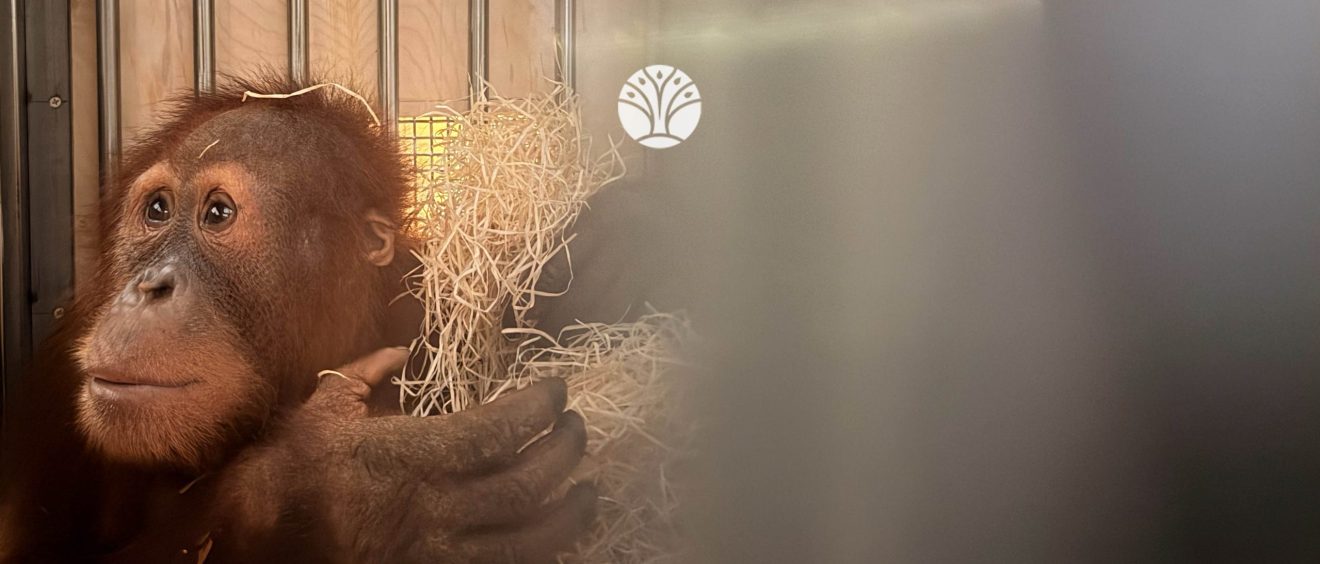
Rocky is a male orangutan who became a victim of transnational wildlife trafficking and was taken out of Indonesia. On November 12th, 2024, Indian authorities rescued Rocky from an apartment in Thane, near Mumbai, Maharashtra, India. At the time, Rocky was estimated to be 18–20 months old.
Following his rescue, the team at Greens Zoological Rescue and Rehabilitation Centre (GZRRC)/Vantara in Jamnagar, Gujarat, India, provided Rocky with intensive care. During his treatment, Rocky reportedly experienced a health condition described as bronchopneumonia or a viral respiratory tract infection. Through medical treatment and intensive monitoring, the GZRRC team helped improve his condition until the medical team deemed him fit to travel back to Indonesia.
The Ministry of Forestry of the Republic of Indonesia, together with various stakeholders, then coordinated efforts to repatriate Rocky. The process required careful preparation, including arranging support throughout the journey, coordinating flights, and maintaining cross-border communication. Cooperation with the Indian government paved the way for Rocky’s return to his homeland.
The Ministry of Forestry and the Ministry of Foreign Affairs, through the Consulate General of the Republic of Indonesia (KJRI) in Mumbai, coordinated the repatriation with support from the Government of India, the Wildlife Crime Control Bureau (WCCB), and GZRRC. Fauna Land Indonesia and the Centre for Orangutan Protection (COP), as wildlife conservation partners of the Ministry of Forestry, also supported the process. Through this collaboration, the team brought Rocky back to Indonesia by air, with Kualanamu International Airport in North Sumatra as the destination.
On October 19th, 2026, Rocky arrived in Indonesia accompanied by the Vantara team and MA Cities India. The Minister of Forestry welcomed him in Medan to mark his return to his homeland. During the ceremony, the relevant parties officially gave Rocky a new name: Heera, meaning “diamond.” The name carries the hope that Heera will become a precious part of orangutan conservation efforts in Indonesia.
Heera has now begun the initial stage of rehabilitation at the Sumatran Rescue Alliance (SRA). Through this process, the team aims to prepare him for a future return to the rainforests of Sumatra, his birthplace.
Rocky’s journey to becoming Heera reflects the deep care and compassion that many people and organizations have shown for Indonesia’s orangutans. We extend our gratitude to the Ministry of Forestry, the Ministry of Foreign Affairs through the Consulate General of the Republic of Indonesia in Mumbai, the Government of India, WCCB, GZRRC, Fauna Land Indonesia, the North Sumatra Quarantine Agency, Angkasa Pura, the North Sumatra Natural Resources Conservation Agency (BBKSDA Sumut), and Orangutan Information Centre (OIC) for their support and collaboration in making Heera’s return to Indonesia possible.
CINTA YANG BESAR UNTUK ROCKY
Rocky merupakan korban perdagangan satwa liar ilegal yang keluar dari Indonesia akibat kejahatan lintas negara. Penyelamatan orangutan jantan ini oleh otoritas India di sebuah apartemen di wilayah Thane, dekat Mumbai, Maharashtra, India terjadi pada 12 November 2024. Saat penyelamatan orangutan tersebut diperkirakan berusia 18-20 bulan. Setelah penyitaan, satwa ini mendapatkan perawatan intensif di Greens Zoological Rescue and Rehabilitation Centre(GZRRC)/Vantara, Jamnagar, Gujarat, India. Dalam masa perawatan, orangutan tersebut sempat mengalami gangguan kesehatan berupa bronkopneumonia atau infeksi virus saluran pernapasan. Melalui penanganan medis dan pemantauan intensif oleh tim GZRRC, kondisi kesehatannya berangsur membaik hingga dinyatakan layak untuk menjalani perjalanan kembali ke Indonesia.
Dengan informasi tersebut, Kementerian Kehutanan bersama para pihak melakukan serangkaian koordinasi dan upaya pemulangan satwa ke Indonesia. Upaya ini tidak sederhana butuh persiapan matang dan upaya lebih karena jarak yang jauh, kesiapan tim membawa orangutan, jalur penerbangan dan juga komunikasi lintas negara yang tidak mudah. Tapi semua menemukan titik cerah ketika pihak negara India merespons peluang kerjasama untuk pemulangan Rocky. Proses ini terlaksana melalui koordinasi erat antara Kementerian Kehutanan Republik Indonesia dan Kementerian Luar Negeri melalui Konsulat Jenderal Republik Indonesia (KJRI) Mumbai, dengan dukungan Pemerintah India, Wildlife Crime Control Bureau (WCCB), dan GZRRC. Fauna Land Indonesia dan Centre for Orangutan Protection (COP) sebagai mitra konservasi satwa liar Kementerian Kehutanan juga turut terlibat dalam proses koordinasi dan pemulangan orangutan ini. Pemulangan dilakukan melalui jalur udara dengan tujuan Bandara Internasional Kualanamu, Sumatera Utara.
Kini Rocky telah tiba di Indonesia pada tanggal 19 Oktober 2026 diantar langsung tim Vantara dan MA Cities India sebagai bentuk nyata kolaborasi antar negara yang luar biasa. Setiba di bandara Medan, Menteri Kehutanan menyambut Rocky sebagai ucapan selamat datang kembali ke Indonesia. Dalam acara tersebut, secara resmi Rocky diganti namanya menjadi Heera yang artinya berlian. Berharap orangutan ini akan menjadi harta berharga konservasi di Indonesia layaknya berlian.
Babak baru orangutan Heera dimulai dengan menjalani tahap pertama proses rehabilitasi Orangutan di Sumatran Rescue Alliance (SRA). Rehabilitasi Heera sebagai bentuk menyiapkan dia untuk bisa kembali pulang ke hutan hujan Sumatera, tempat dia dilahirkan. Heera adalah bentuk banyak cinta dari semua pihak untuk orangutan Indonesia. Terima kasih Kementerian Kehutanan, Kementerian Luar Negeri melalui Konsulat Jenderal Republik Indonesia (KJRI) Mumbai, Pemerintah India, Wildlife Crime Control Bureau (WCCB) GZRRC, Fauna Land Indonesia, Balai Karantina Sumatera Utara, Angkasa Pura, BBKSDA Sumatera Utara, OIC yang telah mewujudkan mimpi kembali Heera ke Indonesia di pulau Sumatera.