POPI’S HIDE AND SEEK

Yellow light entered the window of COP borneo mini clinic. It is half past six. Under the morning light through forest canopy, Popi was playing in the baby house, waiting for meal time and forest school afterwards. That were our routine in the morning. While Popi plays in the baby house, I clean her enclosure, prepare milk for the baby orangutans in enclosure 2, COP Borneo rehabilitation center, East Kalimantan.

What would Popi do when someone approach her?

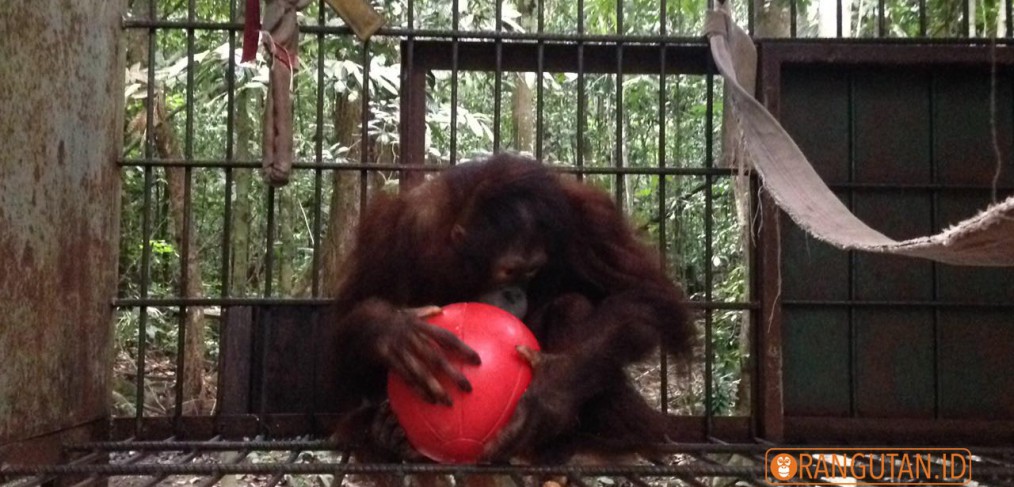
Popi knows that when she plays in the baby house, there will be someone bringing her food. Popi will hide in her favorite spot, inside a blue container. She will hide there while observing the surroundings. Just like kids who like to play hide and seek, Popi will continue to hide, even when her name is called over and over. But she will stay in her favorite spot, leaving the keeper busy looking for her.

Now Popi has a new hiding spot. Volunteers from China provided additional variation to the baby house, built by Angel COP Borneo Project. It is a project of female volunteer from Australia led by Bev Luff from With Compassion and Soul. Baby house is a playing and training arena for baby orangutans to train their muscles and reflexes. When the weather doesn’t allow for forest school activity, the baby house is the destination for the younger orangutans.

Popi’s new hiding spot is a hanging tire. Her small figure allows her to hide in it. Popi will hide until the keeper left. Baby sitter Wetty Rupiana thought her behavior is hilarious.

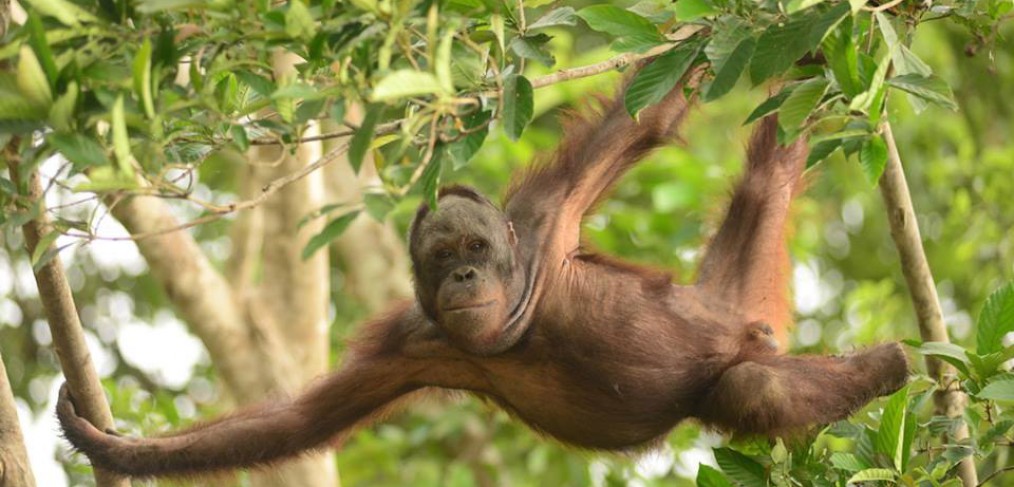
Popi seems very happy to play alone in the baby house. Baby house is the place to express herself. Maybe baby house is comfortable for her, with less denser forest canopy. She was reluctant to go to forest school. She stayed on the top until Wety come and get her. (Zahra_Orangufriends)

POPI BERMAIN PETAK UMPET
Cahaya kuning menembus jendela mini klinik COP Borneo. Waktu menunjukkan pukul setengah tujuh pagi. Di bawah cahaya pagi yang menerobos kanopi hutan, Popi bermain di baby house, menunggu saat makan lalu berangkat sekolah hutan. Ya begitulah kebiasaan kami di pagi hari, Popi bermain di baby house, lalu saya akan membersihkan kandangnya, membuat susu untuk para bayi orangutan di kandang 2, pusat rehabilitasi orangutan COP Borneo, Kalimantan Timur.

Apa yang dilakukan Popi saat ada yang datang menghampirinya?

Popi tahu, saat dia bermainan di baby house, akan ada yang datang membawakan makanan. Popi memilih bersembunyi di dalam tong biru. Tong biru itu adalah tempat favorit Popi bersembunyi sambil mengamati sekeliling. Seperti anak-anak yang suka bermain petak umpet, Popi pun akan terus bersembunyi, sekalipun namanya dipanggil-panggil berulang kali. Semakin sibuk animal keeper mencarinya, Popi pun akan tetap bertahan di dalam tong birunya.

Kini, Popi punya tempat persembunyian baru lagi. Relawan dari China, memberi variasi tambahan untuk baby house yang dibangun oleh Angel COP Borneo Project. Suatu project relawan perempuan dari Australia yang dikoordinir oleh Bev Luff dari With Compassion and Soul. Baby house menjadi arena bermainan yang sangat berguna melatih otot-otot dan refleks para bayi orangutan. Saat cuaca di COP Borneo tidak memungkin untuk ke sekolah hutan, biasanya orangutan-rangutan kecil akan bermain di sini juga. Tempat persembunyian Popi yang baru adalah ban bekas yang digantung. Tubuh kecilnya masih memungkinkan dia bersembunyi di situ. Popi akan pura-pura hilang hingga animal keeper pergi. Baby Sitter, Wety Rupiana nyaris tak bisa menahan tawanya melihat kelakuan Popi.

Popi terlihat senang sekali ketika bermain sendirian di baby house. Baby house adalah tempatnya mengekspresikan dirinya. Mungkin baby house lebih nyaman buatnya, dengan kanopi pohon yang tidak terlalu rapat. Dia pun terlihat enggan untuk berangkat ke sekolah hutan. Dia pun bertahan terus di atas, hingga Wety menjemputnya ke atas. (WET)

SELEKSI DOKTER HEWAN COP BORNEO

Selamat ya untuk dua orang pelamar yang lolos seleksi dokter hewan untuk pusat rehabilitasi orangutan COP Borneo. Pusat rehabilitasi orangutan COP Borneo adalah pusat rehabilitasi satu-satunya yang didirikan oleh putra-putri Indonesia. Kedua dokter hewan yang kebetulan perempuan ini akan mengikuti tahap seleksi selanjutnya dengan terjun langsung di lapangan.

Menjadi tim APE Defender yang mengelola pusat rehabilitasi orangutan bukanlah hal yang sulit namun bukan pula mudah. Setiap anggota tim harus punya kemampuan untuk bekerjasama. Jadi kemampuan akademis saja tidak cukup untuk bisa berkarir di dunia konservasi.

Dalam seleksi kali ini, COP juga mengajak beberapa orangufriends yang berpengalaman di bidangnya. Lewat permainan dan tes terselubung, karakter dan kemampuan dinilai. Semoga orangutan-orangutan di COP Borneo mendapatkan dokter hewan terbaiknya yang mengantarkan mereka lepas ke alam liar nantinya.

JALUR SUNGAI JALAN PULANG OKI

Dalam hitungan hari ke depan, orangutan dari Kebun Raya UNMUL Samarinda (KRUS), Kalimantan Timur akan dilepasliarkan kembali ke hutan. Orangutan Oki adalah orangutan yang telah melalui masa rehabilitasi orangutan di COP Borneo selama 2,5 tahun. Selama 2 tahun terakhir, Oki berada di pulau Bawan, Berau, Kalimantan Timur. Suatu pulau yang dihuni orangutan rehabilitasi yang dipersiapkan untuk kembali ke hutan. Nyaris tanpa campur tangan manusia, orangutan di pulau ini hidup dan beraktivitas.

Persiapan demi persiapan secara teliti dilakukan. Pemeriksaan kesehatan final orangutan salah satunya yang dilakukan tim medis COP Borneo termasuk mengkarantina orangutan Oki. Tak kalah detil untuk persiapan titik rilis orangutan. Tidak mudah untuk mencapai titik ini, karena diharapkan, orangutan dapat langsung beradaptasi dengan kondisi dan cukup pakan di alam.

Dalam rencana, tim APE Guardian memutuskan untuk menggunakan ketinting (perahu dengan jalur sungai) untuk memperjauh jarak namun hemat tenaga dan waktu perjalanan. Daniek Hendarto menjelaskan bahwa, “ Kami akan lakukan yang terbaik untuk membawa pulang Oki ke hutan yang sesungguhnya. Semoga Oki bisa cepat beradaptasi.”.

KATA RELAWAN COP BORNEO

Rasa penasaran itu membawaku sampai di COP Borneo. Memberanikan diri keluar dari zona nyaman, hidup di tengah hutan tanpa aliran listrik, tanpa sinyal telepon 24 jam penuh, jauh dari air bersih dan keterbatasan lainnya. Di sinilah saya memilih menjadi relawan selama satu bulan saja.

Tiba di bandara Kalimarau, Berau, Kalimantan Timur, saya disambut dengan suasana baru, kehidupan baru, rutinitas baru, orang-orang baru dan tentunya cuaca yang baru juga. Hanya dengan melihat teman-teman hebat di sana bekerja, saya menjadi mengerti arti loyalitas terhadap pekerjaan yang sesungguhnya karena mereka bekerja dengan hati atas dasar kecintaannya terhadap orangutan.

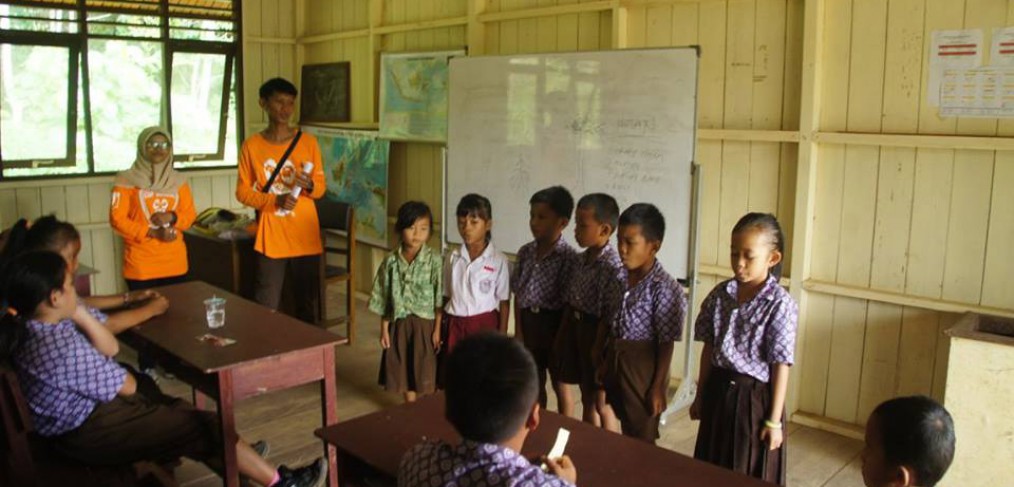
COP Borneo memberikan banyak hal yang untuk pertama kalinya saya rasakan dalam hidup saya. Bekerja di pusat rehabilitasi orangutan mulai dari memberi pakan, sekolah hutan, membuat susu dan membersihkan kandang orangutan. Edukasi ke sekolah minggu dan sekolah lokal di desa Merasa juga menjadi pengalaman berharga buat saya. Patroli pulau pra rilis orangutan menggunakan ketinting adalah pengalaman seru meyusuri sungai kelay. Tak lupa mencuci perahu yang merupakan hasil kerja keras orangufriends di acara musik amal Sound for Orangutan. Dan untuk pertama kalinya juga, saya merasa jengkel pada satwa langka. Ya… si burung rangkong badak itu. Dia dengan nakalnya mencuri buah di gudang pakan dan dengan beraninya menyerang saya.

Tinggal di hutan dengan teman-teman yang ‘seiman’ amat menyenangkan. Satu bulan terasa sangat sebentar. Inilah yang membuat saya memutuskan untuk menambah 3 minggu lagi… dan ternyata masih kurang. Saya menyesal tidak mengambil keputusan menjadi relawan selama 3 bulan dari awal perjanjian. Tetapi, saya akan lebih menyesal jika tidak pernah datang ke COP Borneo sama sekali. (Hedi_COPSchool7)

OWI ESCAPE FROM FOREST SCHOOL

This is the development story of Owi the orangutan. Owi still a role model to Bonti and Happi the orangutans in the last 3 months. Owi the ‘Gang Boss’ recorded undergoing forest school as much as 36 times. The extreme weather that causes the school notes are not taken every day. The baby orangutans are still very frightened when they heard thunder and see lightning flashes.

Bringing Owi to the forest school always keeps animal keepers anxious. For several times Owi escaped during the forest school. This may be due to the location of the forest school which is indeed in controlled by Owi. Owi looks like to explore furher.

But… Bonti who always follow Owi wherever he goes, he held back Owi motion . Maybe that’s why, Owi run away. Tired of facing ‘follower’. In forest schools, the average height of the trees is 30 meters high. Owi usually climb up to the end of the tree. Maybe if the trees in the forest school reach to 100 meters, he will climb up to the tip too. What about the animal keeper watching him > Tucked in gratitude. Forgive us Owi. (Dhea_Orangufriends)

KABURNYA OWI DI SEKOLAH HUTAN
Ini adalah cerita perkembangan orangutan Owi. Owi masih menjadi panutan untuk orangutan Bonti dan Happi dalam 3 bulan terakhir ini. Owi si ‘Bos Geng’ tercatat menjalani sekolah hutan sebanyak 36 kali. Cuaca ekstrim yang menyebabkan catatan sekolah hutan tak setiap hari. Bayi-bayi orangutan ini ternyata masih sangat ketakutan saat mendengar halilintar maupun melihat kilat petir.

Membawa Owi ke sekolah hutan selalu saja membuat animal keeper was-was. Bagaimana tidak kawatir. Owi beberapa kali kabur saat sekolah hutan. Ini mungkin karena lokasi sekolah hutan yang memang sangat dikuasai Owi. Owi terlihat ingin menjelajah lebih jauh.

Tapi… Bonti yang selalu mengikuti Owi kemanapun dia pergi, membuat gerak Owi tidak leluasa. Mungkin itu juga sebabnya, Owi melarikan diri. Capek menghadapi ‘follower’. Di sekolah hutan, rata-rata ketinggian pohon 30 meter. Owi biasanya memanjat hingga ujung pohon. Mungkin kalau pohon-pohon di sekolah hutan mencapai 100 meter, dia akan memanjat sampai ujungnyanya juga. Bagaimana dengan para animal keeper yang mengawasinya? Terselip rasa syukur. Maafkan kami Owi. (WET)

BAMBOO CANE ENRICHMENT

When happi spends his time at the socialization enclosure, the animal keepers are making enrichment for him. These enrichment are to help the orangutans shows their natural instinct. Not only for making them busy, but also to avoid boredom and feeling stressed out being in a cage. Therefore, these bamboos-and-leaves-made enrichment are created for them.

Several kinds of Happi’s favorite fruits are inserted inside the bamboo cane. Guavas, papayas, bananas, and corns are diced, then put into the bamboo cane with a hole on the top of it, then sealed with leaves. And the keepers also add some honey to stimulates their sense of smell and taste bud so they are more excited when opening the bamboo cane.

In the end, Happi needed a quite long time opening the cane. He even asked for our help opening this bamboo enrichment. Perhaps he begins to feel desperate. Happi is in the same enclosure with Owi, Bonti and Pingpong, and they are started to work together. They take turns to smash the bamboo cane, working through the hole, extended their finger and mouth to reach the fruits inside until they finally get the prize.

Would you like to be his adopter? Find this link to adopting him https://www.orangutan.org.au/adoption/adopt/happi/?referrer_source=COP

CAN CHINESE ALSO SAVE ORANGUTAN? (CHINESE VOLUNTEERS 3)

Nowadays, orangutans are not known by many Chinese people. Opposite to popularity of orangutans in China, palm oil is widely used in China.

In the past five months, Indonesian total palm oil production is 151,100,000 tons. Compare to last year, 2016, this production increased thirty-five percent. During those years, Indonesia produce more and more palm oil. Also, as one of the biggest importing country, China is going to import around 5,600,000 tons of palm oil this year. This is about one third of Indonesian palm oil production in the first half year of 2017. And this number also increases every year.

What’s more, China takes part in producing palm oil as well. In China, there are several international palm oil companies, such as Ju Long. In Indonesia, many Singapore and Malaysian palm oil companies’ major shareholders are ethnic Chinese as well. This means, China is not only the main consumer but also one of the primary players of palm oil business in the world and it is unconsciously influencing and damaging orangutans.

In China, we have pop stars, like Jackie Chan, broadcast about the importance of protecting wild animals and advocate people not to buy animal products. However, although they indeed call for guarding wildlife, such as tigers, sharks and so on, they pay little attention to orangutans. Before I became a member of this volunteer work, I had never heard of orangutans, so do people surround me. From the other hand, this may be a good thing because Chinese people can start from origin point to involving themselves into orangutan protection. According to former examples, public advocate is one of the most useful ways. Since Jackie Chan said, ‘No trade will bring no kill. Please do not buy any tiger products.’, the number of tiger products trade has begun to decrease. In the same way, the prospect of orangutan protection in China is very optimistic.

We, our group of six, plan to cooperate with COP members. Since orangutans are not well-known in China, we decide to use our videos which are made of resources we collected in Indonesia to advocate and hold a crowdfunding in Shanghai after we go back. The money we find will be donated to COP to support their assistance of orangutans. Also, through our crowdfunding and speech, we wish the publicity of orangutans in China can be set up.

I am not sure how much help could we bring, but maybe our participation is just the beginning of more Chinese being more involved in orangutan conservation. And that would mean something subtle but significant. (Zi Chen, Jiawei Yang_Orangufriends)

PERSIAPAN RILIS ORANGUTAN DI CAMP LEJAK

Minggu ini adalah waktunya mempersiapkan camp Lejak. Camp yang akan dipergunakan untuk memonitor orangutan setelah dilepasliarkan. Pembelian mesin air, generator pembangkit listrik, perlengkapan tidur dan dapur untuk kebutuhan tim di lapangan. Saat ditata di perahu yang mengangkut barang-barang lewat jalur sungai, muatan melebihi batas muatan perahu. “Ternyata banyak juga ya yang harus dibawa.”, ujar Inoy, penanggung jawab di camp Lejak. Akhirnya, tim terpaksa menyewa satu perahu lagi untuk membawa kebutuhan camp.

Perjalanan sungai memang dipilih setelah mempertimbangkan waktu tempuh dan jalur yang lebih mudah dicapai. Menyusuri sungai selama 1 jam dengan jeram yang cukup lumayan membuat perahu agak oleng-oleng karena sungai yang mulai surut. Bahkan perahu ‘Way Back Home’ sempat kandas karena sungai Kelay yang surut secara ekstrim. Syukurlah menjelang pukul 19.00 WITA, barang-barang sudah masuk camp dengan bantuan teman-teman dari OWT.

Melepasliarkan orangutan kembali ke hutan bukan pekerjaan mudahkan? Dua bulan yang lalu, camp lejak juga baru saja diperbaiki. “Tolong, jangan pelihara satwa liar ya. Karena mengembalikannya, adalah usaha yang panjang dan rumit.”, ujar Daniek Hendarto, direktur operasional COP. Dalam bulan September ini, Centre for Orangutan Protection akan melepasliarkan orangutan dari Kebun Raya UNMUL Samarinda (KRUS) yang telah melalui rehabilitasi di COP Borneo.

ANTARA THREE MUSKETEER ATAU KEMBAR SRIKANDI

Judulnya memang terasa janggal, seolah mempertanyakan ada apa dengan sang tiga sekawan atau si duo lengket tak terpisahkan. Kenapa? Tiga sekawan yang dimaksud adalah kelompok anak-anak orangutan yang sangat kompak di COP Borneo yaitu Owi (2 tahun), Bonti (2 tahun) dan Happi (16 bulan).

Pada suatu hari yang cerah, mereka bertiga pergi ke sekolah hutan bersama si kecil Popi (9 bulan). Uniknya mereka bertiga sangatlah dekat, mungkin karena diletakkan pada satu kandang sosialisasi sehingga mereka sering berbagi waktu yang sama. Selain itu, usia mereka juga tidak terpaut begitu jauh.

Sekolah hutan adalah waktu yang ditunggu-tunggu sebab mereka bebas bermain di hutan hujan tropis. Mereka bisa menjelajah dari satu pohon ke pohon yang lain, menggigit kulit pohon, mencoba berbagai macam daun-daun, berguling-guling di tanah bahkan memanjat pilar-pilar hutan yang menjulang tinggi. Tiga sekawan ini pun terlihat kompak dengan saling berpelukan. Mereka saling berlomba untuk bermain dan mencari kesibukan di hutan. Di antara mereka bertiga, Happi lah yang paling pintar. Ya… dia cukup mandiri dan mampu membuat sarang sendiri di pohon. (A.Gasani_Orangufriends)

WHAT DID WE LEARN FROM COP BORNEO? (CHINESE VOLUNTEERS 2)

I learned about a lot of knowledge of orangutans and COP’s work, even some details that I cannot get from Internet. With deeper comprehensions, numerous thoughts are triggered.

“If we do not do this, then who will?” Reza briskly said. His words were like slight wind, soon ended, but echoed in my brain for a long time. During the seven days we spent with COP members, I saw their love and devotion to orangutans. They are fighters who bravely fight with people who are hurting orangutans, they are families who carefully pay attention to lonely baby orangutans, they are helpers who selflessly help orangutans recover from disasters they experienced. They refuse to accept funds from palm oil companies even though sometimes they face financial problems, one time they had no money for salary. But even in this situation, COP members still took care of every rescued orangutan. These kind characteristics are that I have never seen before from any NGO.

Reza showed us many pictures of orangutans, some of them been well looked after by COP and some of them been badly hurt by workers of palm oil companies. I remember the photo of head of a dead male orangutan most impressively. His eyes closed tightly and his face became less reddish. No-name killer put his head on soil. No forest and vegetation surrounded him. There was only a layer of dirt on his big, alpha face. I could not stop myself from thinking of his majestic appearance when he was alive. I could not stop imaging the moment of his death. Before his eyes are closed forever, did they reflect hate towards humans, sadness for ending of life, or pray for maybe escape? He would have no chance to tell. And we are never going to know about it.

I cannot help myself think about the relationship between human and nature, justice and profits. As we know, COP is the one of the only NGOs which have no economical connections with palm oil companies, even though they will be offered a huge amount of money. “All of us, we do this job because we love orangutans. Money is not really that important to us. One thing we valued is orangutans’ safety and happiness.” That is what Reza told us. And that is what part of COP is unique and heart-warming. Unfortunately, only by hard-working NGO members’ efforts to save orangutans is not enough. Those palm oil companies only have their profits in mind and neglect wildlife, especially orangutans. They are selfish and cold. But one day, when last forest is destroyed by palm oil company, how many orangutans have died? What appearance our earth will be? And how much money they are able to make in the future? Answers are definitely negative. (Zi Chen, Jiawei Yang_Orangufriends)